
Last week, I lost my best friend and business partner, Rosy, an energetic, loving 13-year-old Goldendoodle. She joined our family as a puppy at the very moment I was starting Kids Code Jeunesse (now Digital Moment). She grew up alongside the organisation, and when I left in 2024 to write a book, she helped me transition, trading days filled with back-to-back meetings for long, quiet writing days.
She rarely left my side: a bed beside mine, one at the office (Notman House), and a bright pink pillow tucked under my writing desk while I wrote. And, between the two of us, we were clocking 20,000 steps a day (calculated with my 2 feet @ 5,000 per foot and her 4 legs at 2,500 per patte, for those who like stories told through numbers:). My space is now so quiet. It feels so different. The grief is overwhelming.
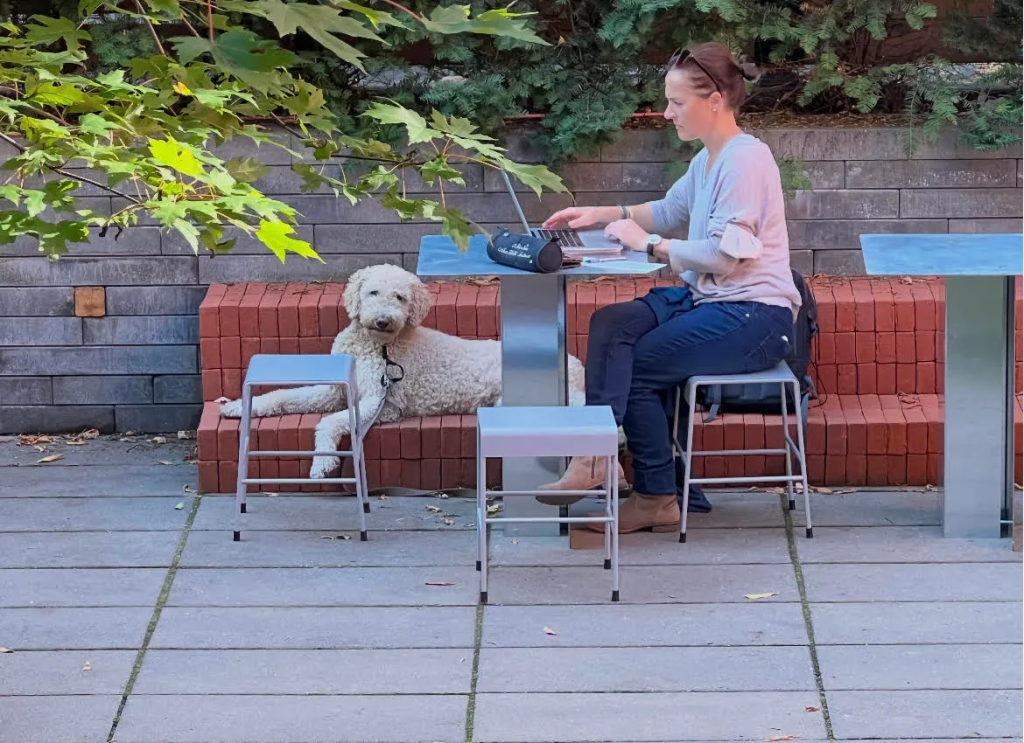
(photo by Alan MacIntosh, Notman House, Montreal. 2021)
Why am I writing about the loss of a dog?
Well, for one, it’s my own healing (thank you for obliging). But also it’s for trying to grasp the meaning of life itself, and this incredible feeling of grief. I have to admit, it is a feeling I have never experienced before (even after losing close family members). Grief is not a data point … it’s empty and full at the same time; close and so far in the same point. It’s like smoke in rainbows, until in a split second, it’s black and white in concrete.
At one minute Rosy was alive and in seconds she wasn’t. Measured by a heartbeat. Does life, existence, relationship die when the heart makes its final push? I don’t know. I don’t think any of us knows and I don’t think, after as much data crunching as AI models can do, they will know either.
In this moment, when so much about work, knowledge, intelligence and even relationships is being challenged by AI, my relationship with Rosy reminds me of the first line I write in Am I Literate?:
“Humans are wonderfully complicated.”
Four words that can fuel a lifetime of debate.
Humans are contradictory. We hurt and are hurt. We love and withdraw. We betray and protect. We are shaped by memory, insecurity, culture, power and longing. Our relationships are layered with nuance, misunderstanding and repair.
But a dog?
Dogs are wonderfully simple. Love, loyalty and friendship.
We have human friends for reasons, seasons or lifetimes. Most relationships sit in the first two categories. Very few reach the third.
Dogs are for a lifetime, and the injustice is that their lifetimes are so much shorter than ours. And what do we learn?
We learn to grieve. We learn to celebrate having loved, and realise that love is boundless. We soften our edges. We discipline routine amidst chaos. We calm our nerves in moments of stress. We know when it’s time to walk, to march, to pause … and to mutter the day’s stresses under our breath, trusting our words (and $%^$%&#$%) will be safely held in the vault of a dog’s friendship.
What life lessons connect with our world today, with ethics in the age of AI? Well, quite a lot.
Rosy reminded me every day that ethics is the invisible border of protection, for people and our planet. It lives in relationships. It is built on trust, transparency, privacy, accountability and the recognition of bias, all elements we are now debating in AI systems, and in our human relationships with them.
Trust & Privacy
Rosy PoV: “Tell me what you need to tell me. I won’t share it.”
Trust is a quiet agreement that vulnerability will not be used against you. As AI systems collect and process vast amounts of personal data, consent is paramount.
Transparency
Rosy PoV: “Say what you need to say. I will still love you.”
In a world of opaque algorithms and hidden data pipelines, transparency is relational. It is about clarity of intent. About not manipulating what others cannot see.
Accountability
Rosy PoV: “You are accountable to walk and feed me, to provide a safe home. If you forget, I will remind you. Even in the biggest snowstorm, I trust you to show up.”
Accountability is not punishment; it is reliability over time. It is the discipline of care. The same must apply to those building and deploying AI systems.
Bias
Rosy didn’t sort the world into categories or rank worthiness (well, maybe if you had a piece of cheese in your hand). She responded to tone, presence, and anyone willing to tickle her behind the ears. There was no optimisation guiding her reactions. She followed her nose, attentive to the moment, and the energies of people around her.
AI systems are different. They learn from existing data, and that data carries the assumptions and exclusions of the world that produced it. They categorise and predict at scale. Without careful design and oversight, they don’t just reflect bias, but also amplify it.
If humans are wonderfully complicated, then ethics must honour that complexity. It cannot be reduced to compliance checklists or technical guardrails alone. It must be rooted in care, reciprocity and responsibility.
And perhaps the most important lesson:
Trust the presence. At a time when AI seems to be able to do almost anything, the scarce resource is not intelligence. It is presence.
Rosy sat quietly beside me – worth its weight in gold.
Rosy didn’t know a thing about machine learning. But she understood relationships. She understood routine and how to listen to the unspoken. She understood when I was anxious before a keynote, when a funding decision weighed heavily, when I needed to step outside and breathe.
She reminded me that relationships are built in the small, repeated acts of showing up. The saying, “trust arrives on foot but leaves on horseback” comes to mind.
As we build and integrate AI into education, governance, business and daily life, perhaps the question is not whether machines can think. It is how do we nuture being deeply human.
Grief, I am learning, is the price of love. And love comes with being accountable and trustworthy in presence — still the most powerful ethical framework we have.
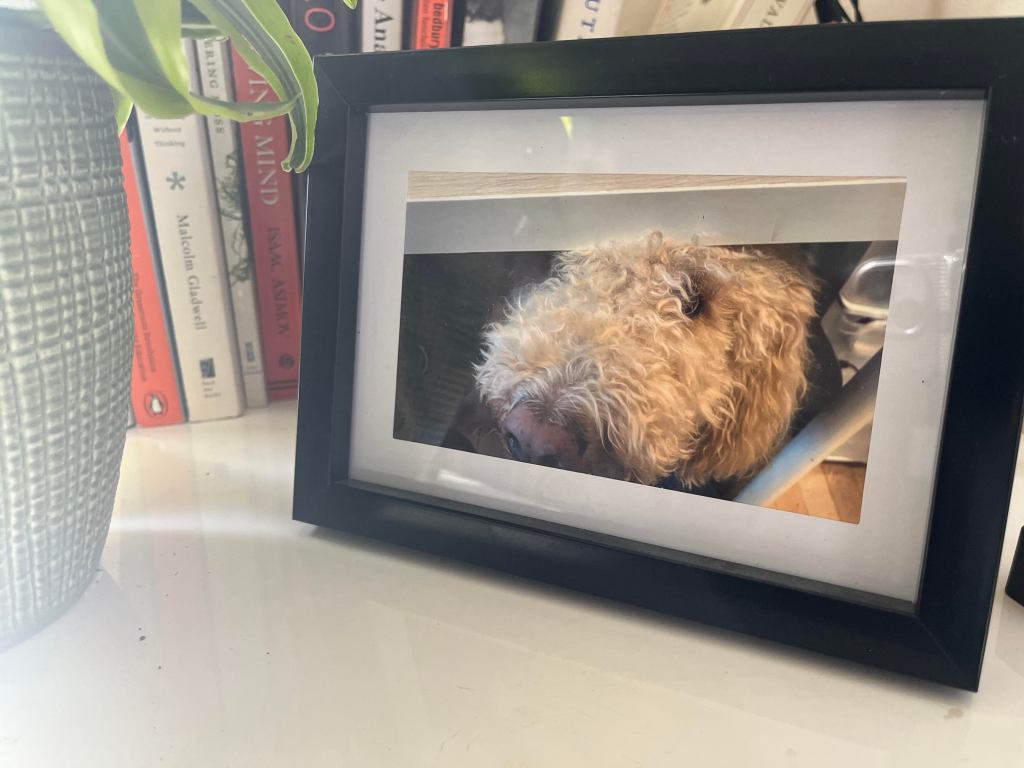
(photo: Rosy peering from my writing desk, 2025)
In loving memory of Rosy, and to all who have loved, lost, and learned.

Leave a comment