
I learned the foundations for reading and writing from the British English education system, and through my parents, but I have spent most of my adult life living in Montreal, Quebec, a city where many flow between the English and French languages with ease. Montreal also sits close to the border of the United States (yes, a quick drive down to Boston or New York City makes for a fun weekend), and with this proximity comes an influx of American culture. While in the physical world, these borders matter. In the digital one, they’re non-existent. Whether wanted or not, even countries far from the US are exposed to The Kardashians and Joe Rogan, thanks to the digital world. This crossing of cultures has impacted words in the process.
Bear with me for a side story.
When I worked in Communications at the Canadian Broadcasting Corporation (CBC) in the early 2000s, I led a project called Montreal Matters, based on NPR’s Chicago Matters. Before launching the pilot, journalist and radio producer Alison and I went down to Chicago to meet the production team and learn the ins and outs of what makes a project successful. Words like “culture,” “local,” “identity,” “voices,” and “words” bubbled to the top over and over again. What makes a place matter includes all of these ideas, not just the letters that form the word, but the actual act of exploring their meanings and anchoring them to a place. Then comes putting sound, stories, and images to the people who make up the reason the place matters. Through the Montreal Matters journey, Alison and her team were able to create a beautiful mosaic of Montreal, which allowed us to continue the project over the next few years. And because of its success, other CBC teams in other parts of Canada started to replicate the project, just as we had done with Chicago. But they too had to go on their own learning journey because the key lesson I learned through our experience was that the city really matters—the colours of fabric that weave together the culture.
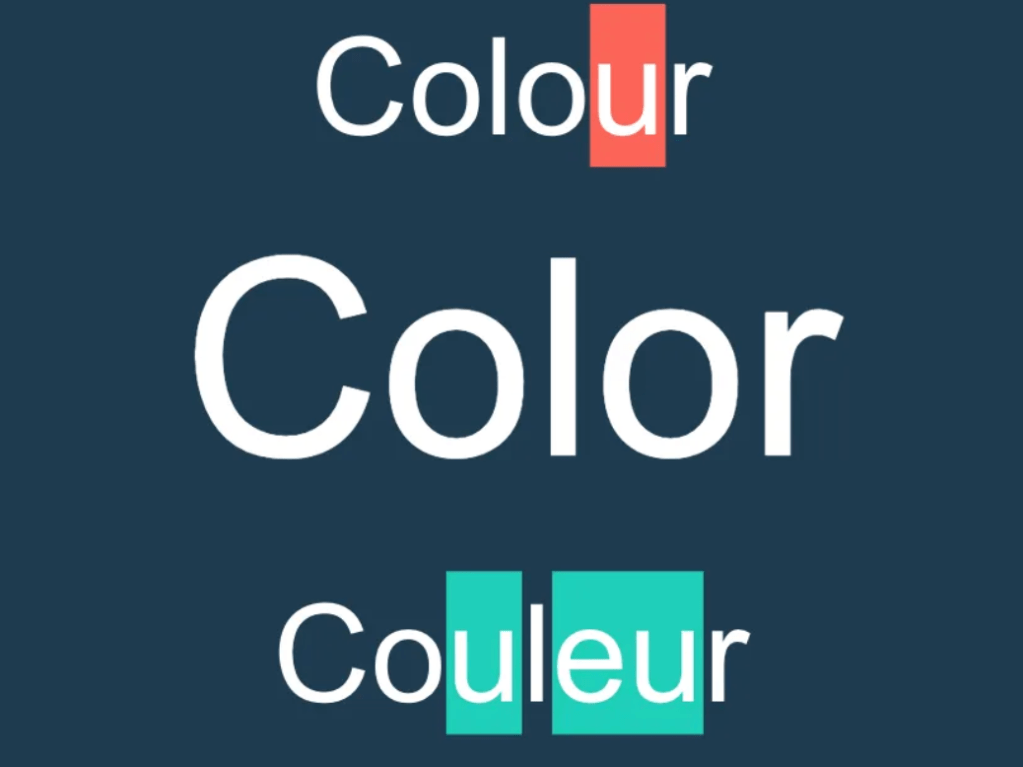
The colours matter. Or should I write “the colors matter”? Or les couleurs comptent? The choice reflects a person’s cultural, historical, and linguistic world. Spelling carries traces of education and identity, from British conventions that preserve older forms, to American simplifications shaped by reform, to French expressions that embed meaning differently altogether. Each variation signals belonging, connection, and identity, revealing how language exposes part of a person’s story and reminding us that even the smallest differences in words can hold the weight of culture.
The colour does matter. Or, increasingly, the model decides, often choosing the American version of the spelling, so that the color matters. Large language models (LLMs) are actively shaping our language, drawing on statistical patterns learned from vast amounts of text. Trained on dominant language patterns, they tend to normalise spelling and reduce variation, contributing to a measurable “homogenisation” of writing style across users. Studies also suggest that even when asked to make minor edits, LLMs will subtly alter wording, tone, and meaning, nudging writers toward more conventional, statistically likely choices. In this way, spelling also becomes a negotiation with an algorithm, often one that prioritises consistency over diversity, quietly deciding which forms of language look “right.” I only have experience with languages using the Latin alphabet, but similar dynamics appear across other writing systems, each with their own markers of history and identity (further reading on this in MIT article below on English/Chinese models).
And, for someone like me who can spend hours editing a sentence, it’s scary—and also confusing. Should I edit ‘prioritises’ to ‘prioritizes’? Do I feel more British or Canadian today?
Don’t let LLMs erase your way of telling stories. If you’re using LLMs to write your next LinkedIn post or company newsletter, be specific in your prompt. Ask it to write in “Canadian English” or “French Canadian.” It matters to our culture, and it’s up to us—not an LLM—to protect it.
Best,
Mum…Mom…Maman…(?)
Further Reading
The Times -AI writing is on the rise — can you tell between a human and a bot?

Leave a comment