
Beyond the Hype: Where do we fit AI and the human skills?
Just like the word literacy, fluency is increasingly used in conversations about skills and AI, and as these terms are repurposed, it becomes harder to keep sight of their meaning.
And their meaning matters when it comes to what we need to do to prepare communities to thrive in this period of massive disruption. The purpose of education is to ensure people have the skills, knowledge, and access to tools needed to participate as socially and economically engaged citizens. So from this perspective, where do literacy and fluency fit in education today?
Before introducing AI, the terms can be defined simply:
Literacy is having the valued and socially accepted skills, knowledge, and tools necessary to create, communicate, and understand information.*
Fluency refers to the ability to express and apply knowledge easily, smoothly, and effectively. While it is most often associated with language and speech, it also applies to reading, movement, and thinking in real time. (1)
And with a story…
One skill that has never come naturally to me is learning new languages. As a child living in Argentina, I learned Spanish and was able to read, write, and speak with friends, engage in my community, and participate in daily life. While I wasn’t fluent, I could function without difficulty. In other words, I had developed basic literacy skills.
When we moved to Montreal, my environment shifted to French. Over time, French displaced my Spanish, and for the past 30 years I have been working towards fluency in French. I can communicate and manage most situations, but I am not fluent despite sustained efforts. I attended a bilingual high school, completed my MBA in both languages, live in a predominantly French neighbourhood, and have worked with a private tutor. I listen to Paul Arcand’s La revue de presse each morning, practise daily on Duolingo, and speak French regularly with a close francophone friend. Still, I am not fluent.
In this case, fluency refers to the ease, adaptability, and the ability to respond in real time. Whereas literacy means having the foundational skills needed to navigate through the world. This distinction is important when considering the current use of literacy and fluency in AI education.
In workplace settings, fluency is important. According to Deloitte “Fluency refers to how adept a person is at understanding or using a particular skill or language. AI fluency, then, is how skilled a person is in understanding, using and effectively collaborating with AI tools.” (2) But as a system-wide educational goal, however, it is less clear. AI systems evolve rapidly: interfaces change, capabilities shift, and what is learned today may not apply tomorrow. Building education around AI fluency risks anchoring learning to tools that will not remain constant, focusing on mastering the tool rather than strengthening the person.
So what about this? Education systems should prioritise a combination of AI literacy and human fluency.
AI literacy provides the foundation. It supports understanding of how AI systems function, how data shapes outputs, where bias can emerge, and how these tools influence decisions and information. It involves the learning needed for people to communicate and create with AI.
Human fluency is grounded in human agency. It is the ability to apply judgement, think critically, communicate clearly, collaborate with others, and adapt in changing conditions. It involves integrating these capabilities in real time (rather than the AI fluency skills), across contexts, and often alongside machines.
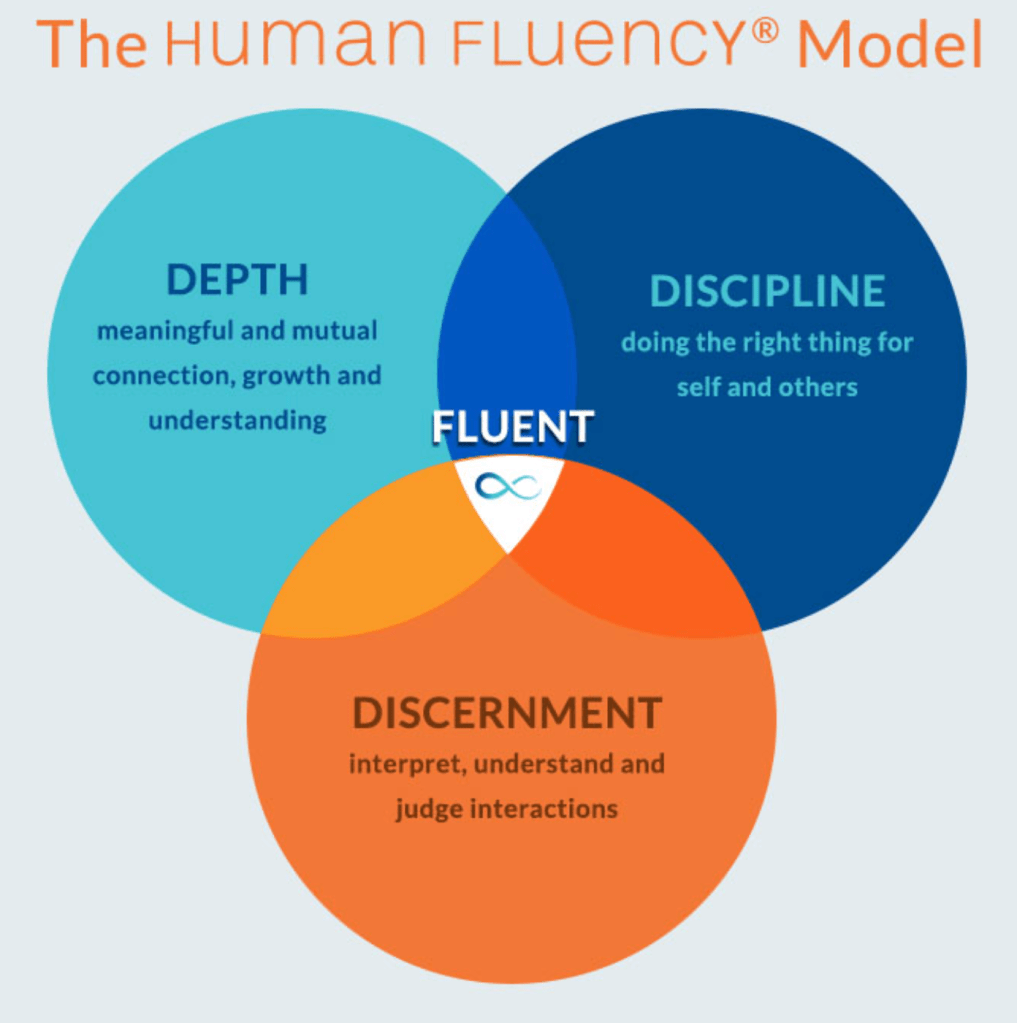
In researching this argument, I have to admit there is very little on the term fluency, let alone on AI fluency and human fluency. However, I came across the Human Fluency Model (image below), which I really like and have used to strengthen my understanding of what it means to be fluent with AI. The more I read, the more convinced I become that mastery of human skills, rather than mastery of AI, is crucial to healthy and inclusive societies.
humanfluency.com
AI literacy informs understanding; human fluency enables action, whether between humans or between humans and machines. Together, they support responsible and effective interaction with AI systems while building strong human skills.
This becomes more important with the rise of agentic AI. Systems are beginning to move beyond generating content to carrying out tasks, making decisions, and executing multi-step processes with limited human oversight. In this context, knowing how to use a tool is not sufficient. Individuals need to decide when to use it, why to use it, and how to assess its outputs. This requires human judgement, context, and responsibility. (3)
Focusing on AI literacy and human fluency offers a more stable foundation for education. Tools will continue to change, but human agency, expressed through the ability to think, communicate, collaborate, and make informed decisions, remains essential. Equally important is cultivating an understanding of culture, empathy, and human interaction, including the capacity to approach others with depth, the discipline to act appropriately in context, and the discernment to interpret and respond thoughtfully to social situations. (4)
Education, whether K-12, post-secondary, or even workforce training, should prioritise strengthening human fluency alongside developing the skills and knowledge needed to understand and work with AI systems.
Maintenant, je m’en vais écouter la revue de presse de ce matin.
Kate
LEARN:
OECD webinar on The rise of Agentic AI (Mar 30 2026)
AI Agentic course by Deeplearning
Sources
*based on my work from Am I Literate? Redefining Literacy in the Age of Artificial Intelligence
(1) readinguniverse.org/article/explore-teaching-topics/fluency/what-is-fluency
(3) http://www.ibm.com/think/topics/agentic-ai
(4) humanfluency.com

Leave a comment