
On September 8 2025, I delivered the keynote at UNESCO in Paris for International Literacy Day, joining UNESCO Assistant Director-General for Education Stefania Giannini
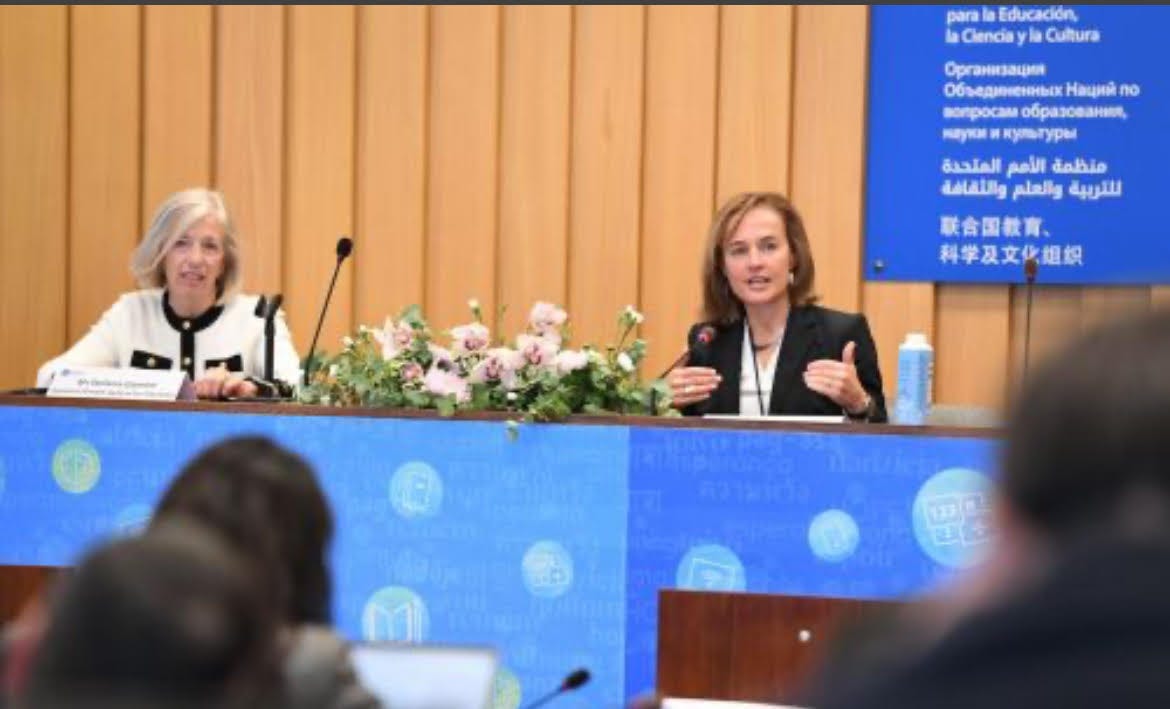
(UNESCO September 8 2025)
There is not a time that I can recall when I could not read or write. A sign of privilege—tied to my access to education, one that continued through to university with my first degree in English Literature in 1996. I was raised in a rich learning environment, with an abundance of books, storytelling, and support from incredible educators.
I was born in the UK, raised and educated in Nigeria, Argentina, and Saudi Arabia—before finally settling in Canada. My family and friends were spread across continents. Our relationships connected and continued through the power of the written word.
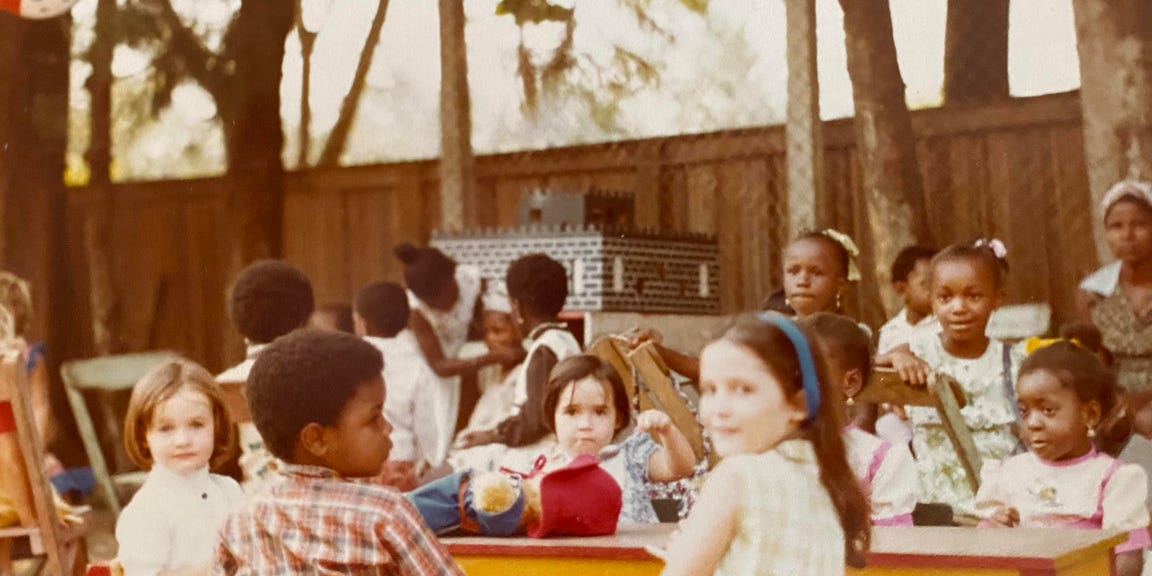
(photo: 1977 at school with sisters, Lagos, Nigeria)
By the age of seven, I was writing stories of my own and sending lengthy handwritten updates to loved ones overseas—full of the trials and tribulations that come along with being a young girl.
Moving between languages and cultures taught me that literacy means more than having the ability to read and write. Its definition and significance shift depending on context and time.
Literacy includes having the knowledge, skills, values, attitudes, and behaviours to connect, to share, and to engage—with each other and within society.
I can still hear my mother’s voice saying: “The pen is mightier than the sword!” “Choose your words wisely, Kate!” And… “Don’t forget to write to your grandparents!”
Her persistence and encouragement are what I needed to become literate—to develop a lifelong appreciation for learning, to continue strengthening my abilities to understand, interpret, and share information in the world around me.
Through education—whether at home, in a community setting, or in a classroom—we practice and improve our literacy skills. They equip us to participate in the labour market… to engage fully in civic life… and to contribute to the cultural, economic, and social fabrics of our communities. Throughout history, literacy has also been a driving force behind industrial revolutions and behind the waves of innovation we have seen over the past few centuries.
During the First and Second Industrial Revolutions, reading, writing, and numeracy allowed citizens to adapt to new workforces, boost productivity, and participate in public duties like voting.
Mass education campaigns and government support laid the foundation to build skilled workforces that drove progress.
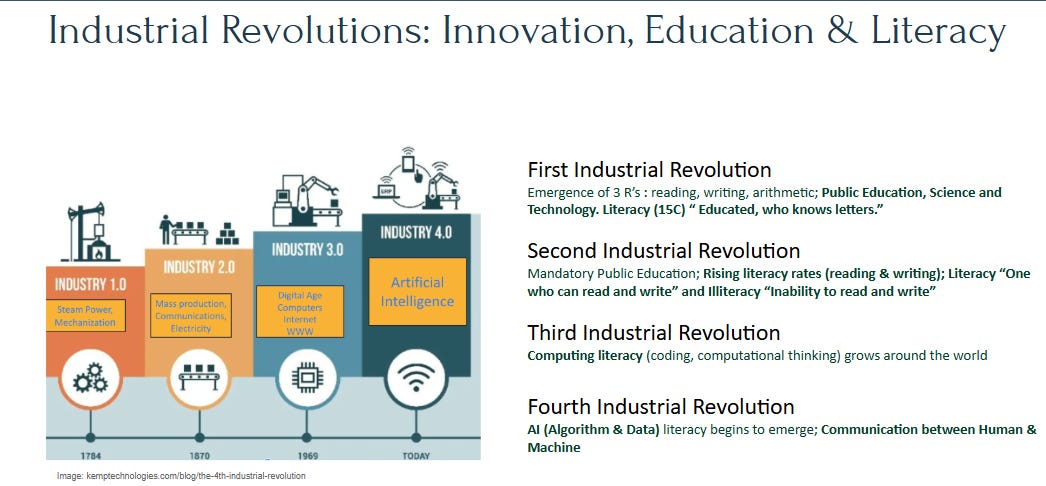
But literacy has never stood still and requires constant attention. It evolves alongside society’s changing needs.
In the Third Industrial Revolution, computers emerged. A digital world was being formed. People needed not only to communicate and create with digital tools, but also to learn how to build them. Coding, physical computing, and computational thinking skills became essential, as did the digital infrastructure key to transmitting and sharing information. This allowed us to participate in the digital space—one that mirrored, both the good and the bad, of our physical world.
Just as in the Third Industrial Revolution, today the Fourth Industrial Revolution is again transforming how humans engage. Advances in AI, robotics, and other technologies are changing the way information is accessed, processed, and shared.
For the first time, humans are not the only ones who can access data, transform it into knowledge, and respond meaningfully. So too can machines.
And unlike past revolutions that unfolded over decades, today’s advances are accelerating at exponential speed—reshaping economies, workplaces, and even daily communication in real time.
This is why literacy today must include learning the skills and having access to the tools to communicate and create in a digital world, one that now includes artificial intelligence.
Artificial intelligence, or AI, is not new.
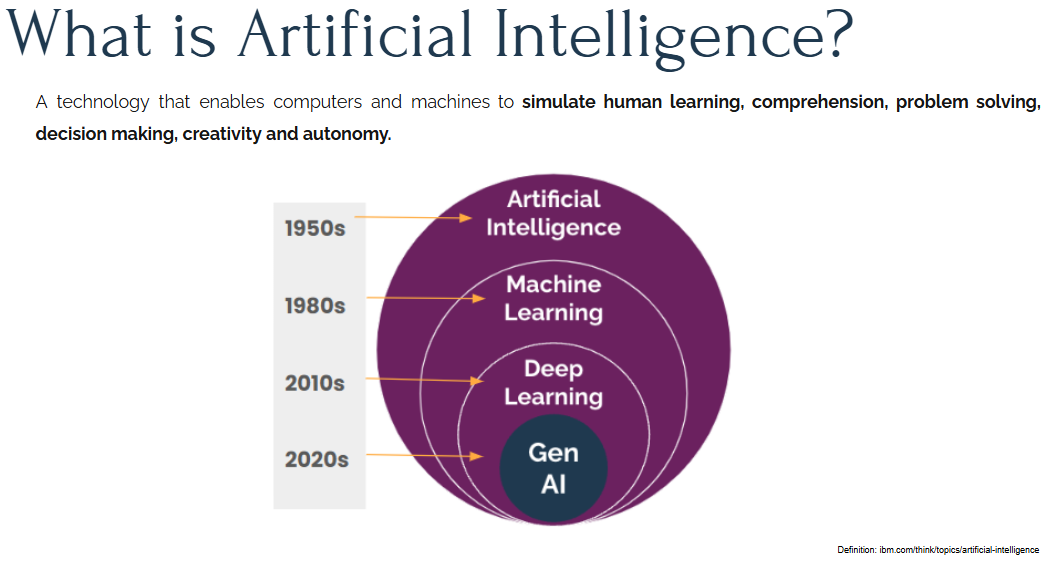
In the 1950s, researchers and scientists asked the question: “What if a computer could mimic the human brain?”
Over the years, there have been ebbs and flows of advancements. And in the last few decades, technological breakthroughs have led us to AI’s incredible abilities we experience today—such as deep learning methods that enabled breakthroughs in image recognition, and transformer architectures that gave rise to large language models capable of generating human-like text—moving us into yet another wave of rapid innovation and massive disruption.
AI helps doctors diagnose disease. It translates languages in real time. It will continue to augment and automate many tasks that were once only possible by humans, and even do tasks that were never humanly possible, and are now beginning to do so autonomously.
We see it curating the media we consume, streamlining work in offices, and supporting farmers in monitoring crops with precision—evidence that AI is becoming woven into every sector of society. AI is already shaping our world and will continue to blur the lines between the physical and digital, human and machine.
When we understand AI, we can question it. We can shape it. And we can build and use it responsibly.
As with literacy, there are many definitions of AI, shifting and transforming in context and time. In simplest terms, AI is a technology that enables computers and machines to simulate human learning, comprehension, problem-solving, decision-making, creativity, and autonomy.
Like humans, AI systems take in information, whether words, numbers, sound, or other forms of data, and generate outputs. AI learns by analysing data, identifying patterns, and applying those patterns to make decisions, solve problems, or communicate—often in ways that seem remarkably human.
But they still rely on humans, requiring large datasets that are trained and labelled by humans, and human interaction in the form of clicks, actions, and even camera footage. They also rely heavily on Earth’s natural elements—land, water, energy, and minerals—requiring resources that are scarce in parts of the world.
This means AI literacy must also teach us to think critically about sustainability, transparency, and the human values we embed in these technologies.
Understanding how AI works, knowing how to use it responsibly, and learning how to question its outputs must now be part of what it means to be literate.
AI literacy includes having the knowledge, skills, and tools to interact with AI while recognising its ethical implications, both on people and on the planet. Achieving meaningful participation with AI requires access to tools and the networks—the internet, computers, and digital infrastructure—just as pencils and paper were once essential for learning to read and write.
Yet nearly 3 billion people still live without internet access.
This digital divide prevents entire communities from fully participating in education, economies, and the digital society many of us take for granted. It risks excluding people not only from using AI, but also from gaining the understanding and skills needed to engage with it. Without closing this gap, AI risks widening inequalities—creating a world where some shape the future, while others are left behind.
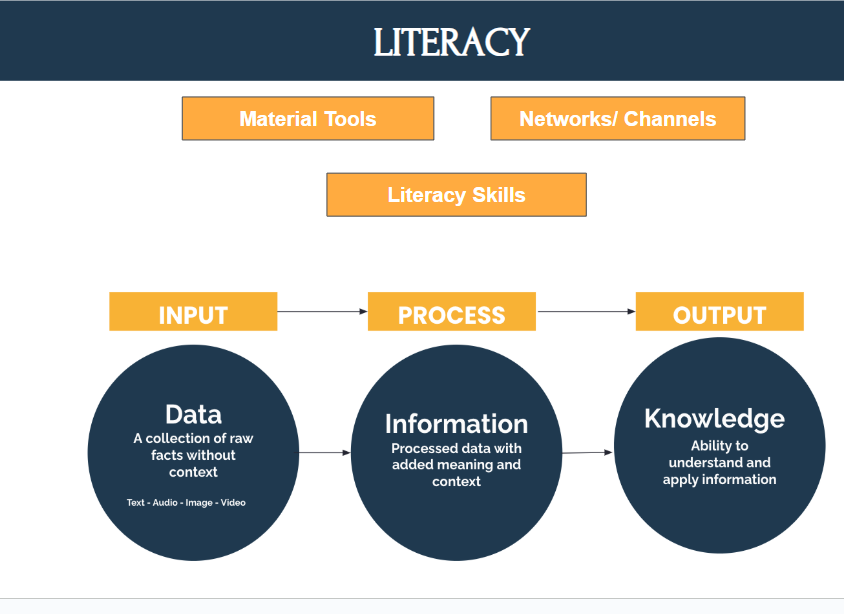
AI literacy must also build on traditional and computing literacies—not taught in silos, but collectively, to build sustainable, lifelong learning literacy skills. And to bridge literacies to help, not hinder, progress.
Reading and writing help us craft meaningful prompts and interpret AI-generated content. Numeracy allows us to analyse data and understand how machines process it, and how we build and use mathematical AI models.
Computing literacy equips us to see how the hardware and software of machines work and how they connect us to the digital world.
AI literacy extends these foundations by adding another layer: the ability to discern when to rely on machines, when to recognise their boundaries, and when human judgement must be used. Alongside, we must strengthen our distinctly human skills: creativity, critical thinking, empathy, and ethical reasoning. And we cannot forget humans’ capacity to build community.
We must also learn to use AI tools to strengthen and support our human abilities.
I have witnessed this personally. One of my daughters struggled with school. Not because she isn’t capable—far from it. She has always been able to build strong relationships and has a natural ease with communication skills. But reading was her challenge. In classrooms where materials were heavily text-based, her learning difficulties made every lesson and every assignment a struggle. By the age of 17, in her last year before deciding whether to go on to university, she said, “Mum, I don’t think I can continue. It’s just too hard.” She would wrap up the school year and explore her options.
And then she learned of a new AI tool—one that transformed written materials into audio and podcasts. A tool that was able to input data in one form and output it in another. She used it through the final school semester, and everything changed. Her grades rose, and more importantly, so did her confidence. At the end of the year she said, “Mum, after so many years of feeling stupid, I finally feel smart.”
Without the AI tool, my daughter would have left formal education. Instead, on September 2nd, just last week, she began her first year of university—equipped not only with the right support, but with the belief that she can succeed.
Her story is just one example of how AI, when used thoughtfully, can make education more inclusive, support literacy skills, and expand opportunities where traditional systems have fallen short.
So where do we begin?
We begin with open curiosity. Curiosity is like wandering the winding streets of a new city without a map.
There is uncertainty, yes, but also the anticipation of discovery.
This openness builds our confidence in the unknown.
Through literacy, we learn to connect with our surroundings—recognising patterns, making connections, and creating meaning from the data around us to forge a path forward.
Be curious about what AI can—and importantly, what it cannot—do.
With AI literacy, we maintain and strengthen human agency with machines: we learn how they work, how they process data, find patterns, and we learn how AI can contribute to advancing our own journey and help our communities thrive.
And by nurturing curiosity, we ensure that AI remains a tool for human empowerment rather than human replacement—helping us ask better questions, seek deeper understanding, and imagine new possibilities for learning.
On this International Literacy Day, let us remember that literacy has always been a collective effort and will continue to be so. It lifts communities. It ensures equal participation. It shapes societies.
Whether through the written word, numbers on a page, a line of code,
or data in an algorithm—to be literate is to know how to transfer data into knowledge, to share that knowledge with others, to record it into history, and to have the incredible gift of belonging.
amiliterate.com

Leave a comment